
Resolve the quantity and active basis
Ask for net commercial mass, stated fill, density definition, units and the conditions used for measurement. Density converts liquid volume to commercial mass; it does not indicate active fraction.
Request the supplier's definition of active content separately. Total solids or nonvolatile material may include components other than the polymer. Keep the original document basis with every cost calculation.
Calculate consumption without confusing stock and product
Distinguish neat emulsion delivery from the final prepared-solution flow. Multiplying diluted flow by neat-product density would overstate consumption.
The form-conversion guide explains active-mass normalization. Compare each qualified grade at its own accepted dose and preparation conditions; equal active mass does not guarantee equal treatment response.
Check the activation installation
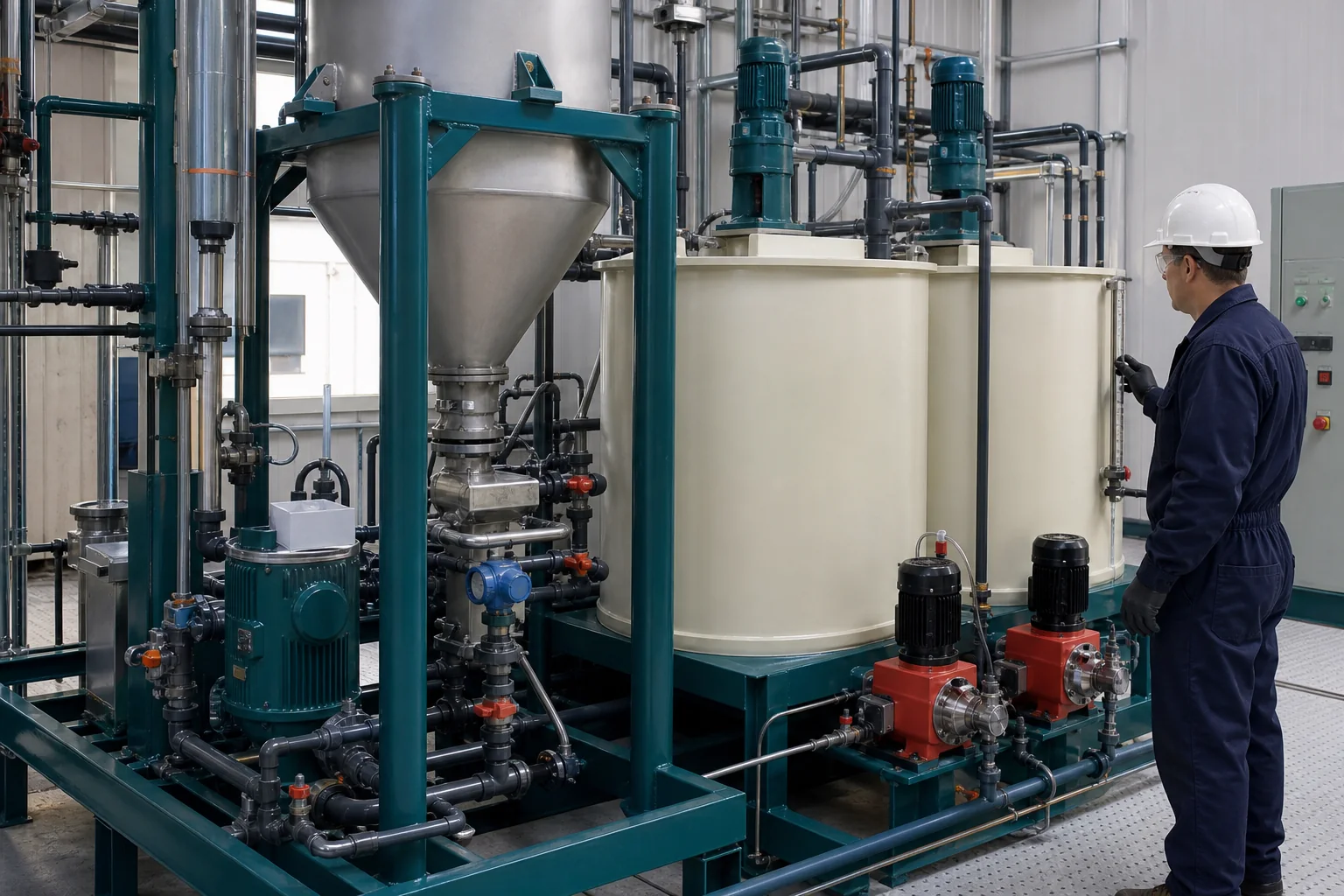
Confirm water pressure and quality, dilution sequence, activation device, maturation, transfer and secondary dilution against product instructions. An emulsion is not automatically ready for direct injection.
Verify pump calibration with the operating material. Keep low-load metering and peak demand visible. A liquid alternative that requires an unplanned skid or cleaning procedure needs that scope in the quotation.
Review IBC receiving and storage
Agree package specification, net quantity, batch identification, storage instructions and compatibility with the plant's discharge arrangement. Confirm how residual material, empty packaging and partially used containers will be handled.
Do not assume a universal storage temperature, shelf period or transport classification from the word emulsion. Use the grade's SDS, supplier instructions and the responsible logistics and safety review.
Request a complete commercial offer
State trial quantity, monthly demand, destination, handling capability and accepted separator target. Separate packaging, freight and one-time conversion costs from repeat product consumption.
Use the IBC emulsion quotation request to obtain a named product and preparation proposal. Release the purchase only after the IBC handling and treatment result are both accepted, retaining benchmark stock during the changeover.
A hypothetical volume-to-active-mass check
For unit illustration only, 100 litres of neat emulsion at a hypothetical density of 1.05 kg/L represents 105 kg of commercial product. At an independently declared hypothetical active fraction of 0.40, that mass contains 42 kg active polymer. These numbers are not Xinqi product values.
Record the actual supplier values and their reporting basis before using the calculation. Apply it to neat product, not the final diluted solution flow, and reconcile with measured container consumption. Differences due to residual IBC material, transfer losses or stock-level changes should remain visible instead of being interpreted automatically as a change in polymer activity.