
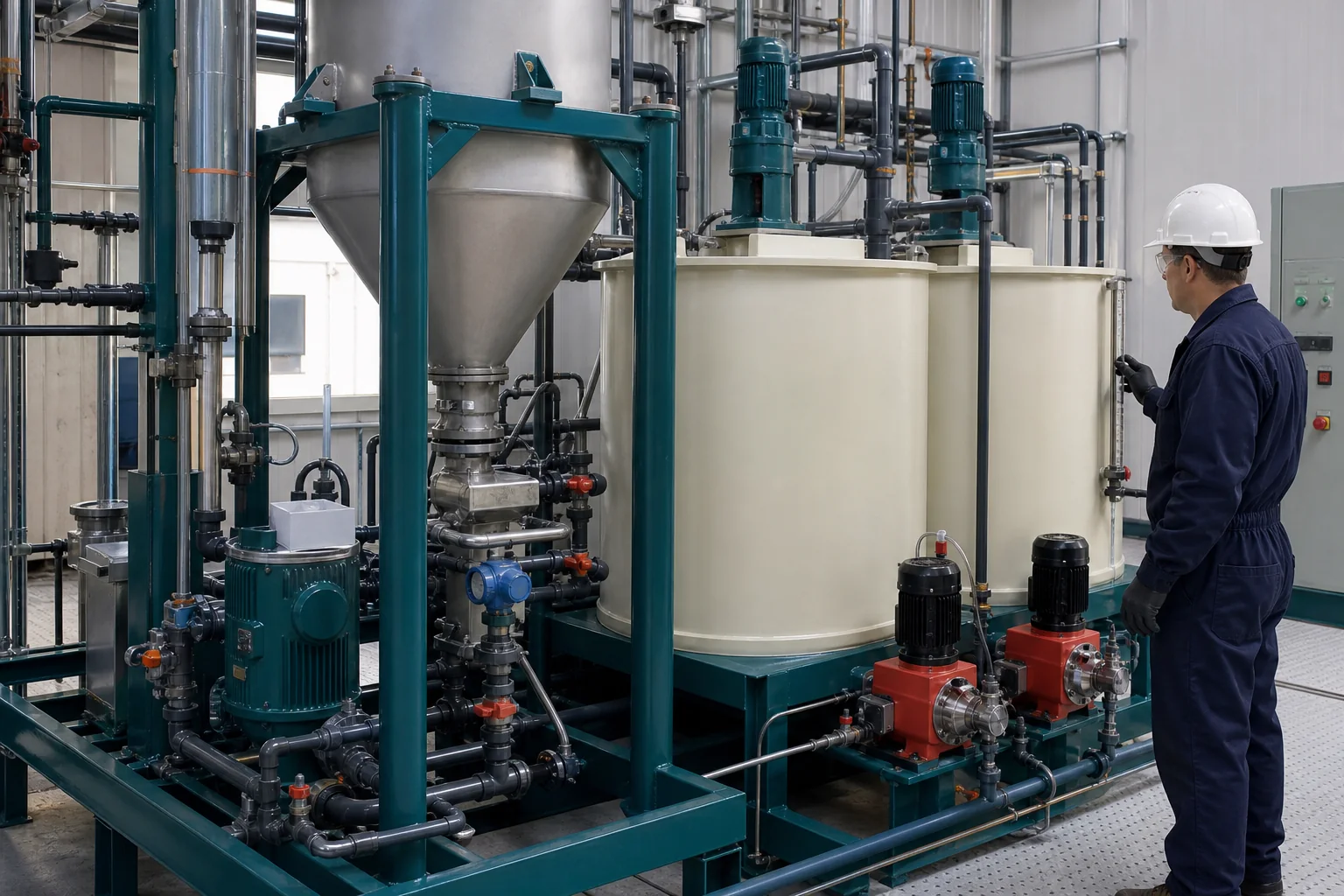
Define what age means in the system
Record when preparation starts, when product addition ends and when solution becomes available for use. In continuous systems, tank residence and mixing determine an age distribution rather than a single batch timestamp.
Nominal tank volume divided by average flow is only a first estimate. Dead zones, short-circuiting, level changes and intermittent draw-off can change the actual material reaching the dosing pump.
Keep wetting and maturation separate
For powder, individual particles must disperse before swelling creates gel-coated lumps. Later agitation does not necessarily recover a poorly wetted batch. For emulsion, the specified activation sequence must release polymer into the water before the prepared solution can be fairly evaluated.
A solution that looks uniform is not conclusive evidence of repeatable treatment response. Compare performance at controlled preparation conditions and use product-specific instructions for the maturation and use period. There is no universal aging time suitable for every CPAM grade and water supply.
Investigate a shift-related pattern
Compare powder or liquid feed calibration, water source and temperature, working tank level, concentration, mixing and use rate between shifts. Include weekend shutdowns and startup batches. Look for undocumented top-ups or mixtures of new and old stock.
Sample equivalent points only after the relevant tank is mixed. A top sample immediately after filling and an outlet sample later in a run do not necessarily represent equivalent solution.
Run a bounded preparation comparison
Prepare an identified product under controlled conditions, retain the relevant timestamps and test on the same representative feed at selected practical ages. Record the separator response and solution observations without assuming that viscosity alone proves activity.
If the fresh controlled preparation works and production stock does not, investigate make-down and delivery. If both fail on current feed, revisit feed identity or product selection. This paired comparison is more informative than repeatedly increasing concentration.
Write a usable operating standard
Specify the product code, preparation method, concentration convention, minimum maturation condition, allowable use period from the supplier, and what to do with uncertain material. Label batches and record tank turnover. Keep storage and spill handling aligned with the supplied SDS.
Connect the standard to the powder preparation constraints or emulsion activation requirements. For receiving checks, apply the same method used to approve the original sample so a new lot is not judged under a different procedure.
Related purchase decisions
- CPAM Powder for Existing Feeders: Specify Particle Distribution — Buy cationic polyacrylamide powder against actual feeder output, wetting, hydration and handling instead of a nominal mesh label.
- CPAM for Cold Preparation Water: Check Usable Stock Capacity — Qualify cationic polymer supply for winter preparation using product instructions, maturation, working volume, viscosity and peak process demand.