
Define production and cleaning states
Record product campaigns, cleaning discharges, flow, temperature, pH, solids and the relevant oil or fat measure. Include recurring difficult batches rather than an easy midday sample alone.
Identify which streams are combined before flotation. A change in cleaning chemistry or production mix can alter the feed at polymer injection even when the plant's industry name stays the same.
Establish upstream controls
Document pH correction, coagulant code, concentration, dose and contact. Compare untreated and coagulant-only conditions where useful before assigning improvement to polymer.
Keep these variables stable while screening CPAM. A polymer cannot be presumed to repair unresolved emulsification, precipitation or air-delivery problems; each needs its own operating diagnosis.
Include bubble contact in acceptance
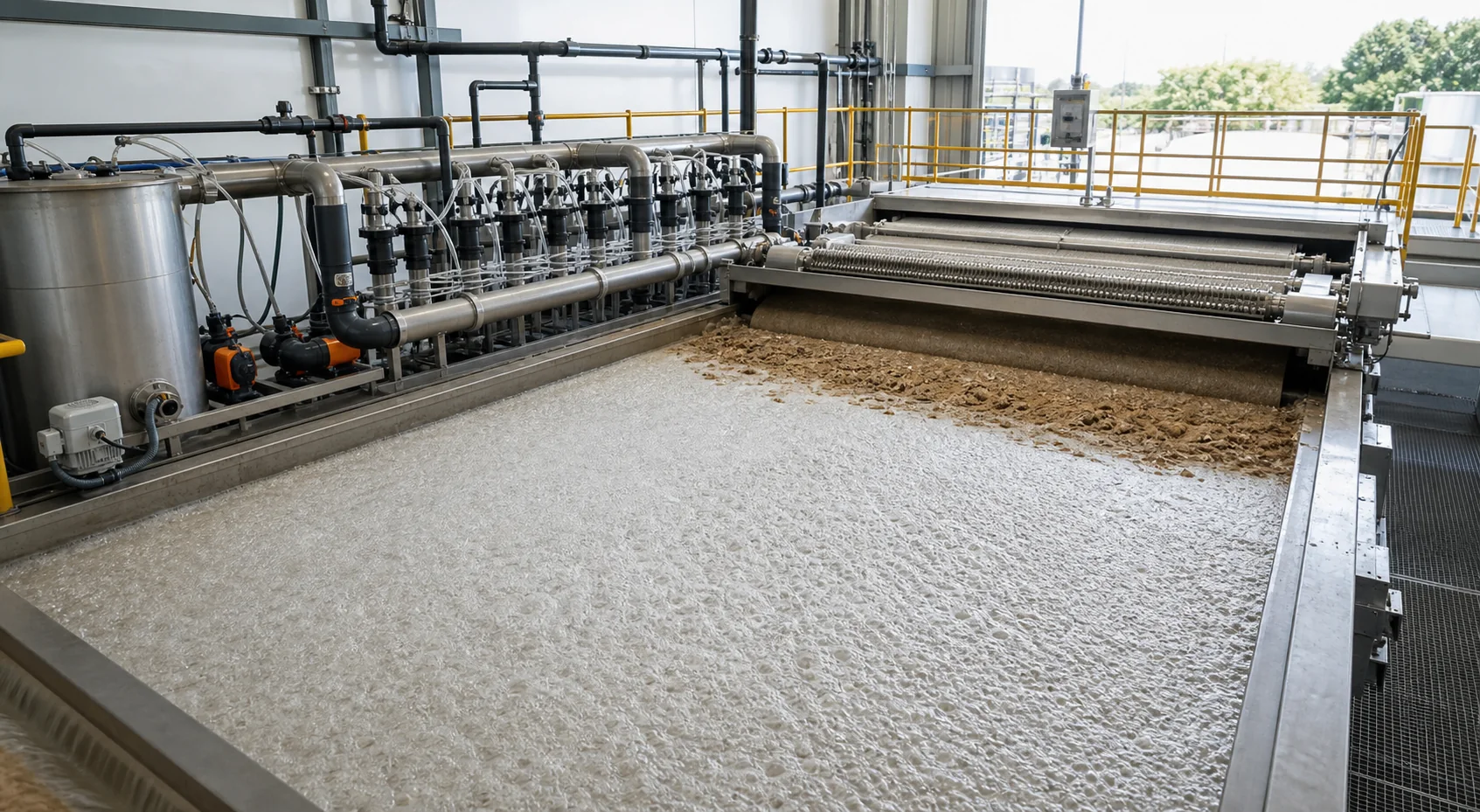
Use suitable flotation testing and record recycle or air conditions, contact and observation time. Compare rise behavior, float integrity and water quality below the floated layer.
A fast-settling jar is not sufficient evidence for DAF approval. The DAF application route separates conditioning from the hydraulic and flotation requirements that the product must meet.
Follow floated sludge downstream
Measure float concentration, skimming, transfer and any later dewatering. A stable floated layer that becomes difficult to pump or condition can add cost outside the DAF itself.
At plant scale, record throughput, recycle and skimmer settings with the chemical dose. Avoid attributing an improvement to polymer when the air or hydraulic loading changed at the same time.
Set the procurement boundary
State required water measures, accepted float handling, feed range, trial quantity and intended packaging. Any regulated reuse or food-contact claim needs separate grade-specific verification; wastewater performance does not establish it.
Send the production and treatment record through the food-process DAF polymer request. Ask suppliers to propose named candidates with explained differences and a bounded trial, rather than guaranteeing a universal dose for all food-processing wastewater.
A production-state flotation test matrix
Create separate rows for the important production and cleaning states, then record feed condition, pH correction, coagulant, CPAM code and commercial dose. Preserve bubble-contact and observation conditions beside float and water measurements. A result from a different chemical sequence belongs in a separate comparison.
Identify which treated-water targets are measured directly and which remain outside the flocculation trial. If the plant needs removal of a dissolved constituent, do not replace that analysis with a clarity observation. Mark untested production states explicitly and use them to size the next trial rather than treating one favorable food-process sample as an unrestricted supply approval.