
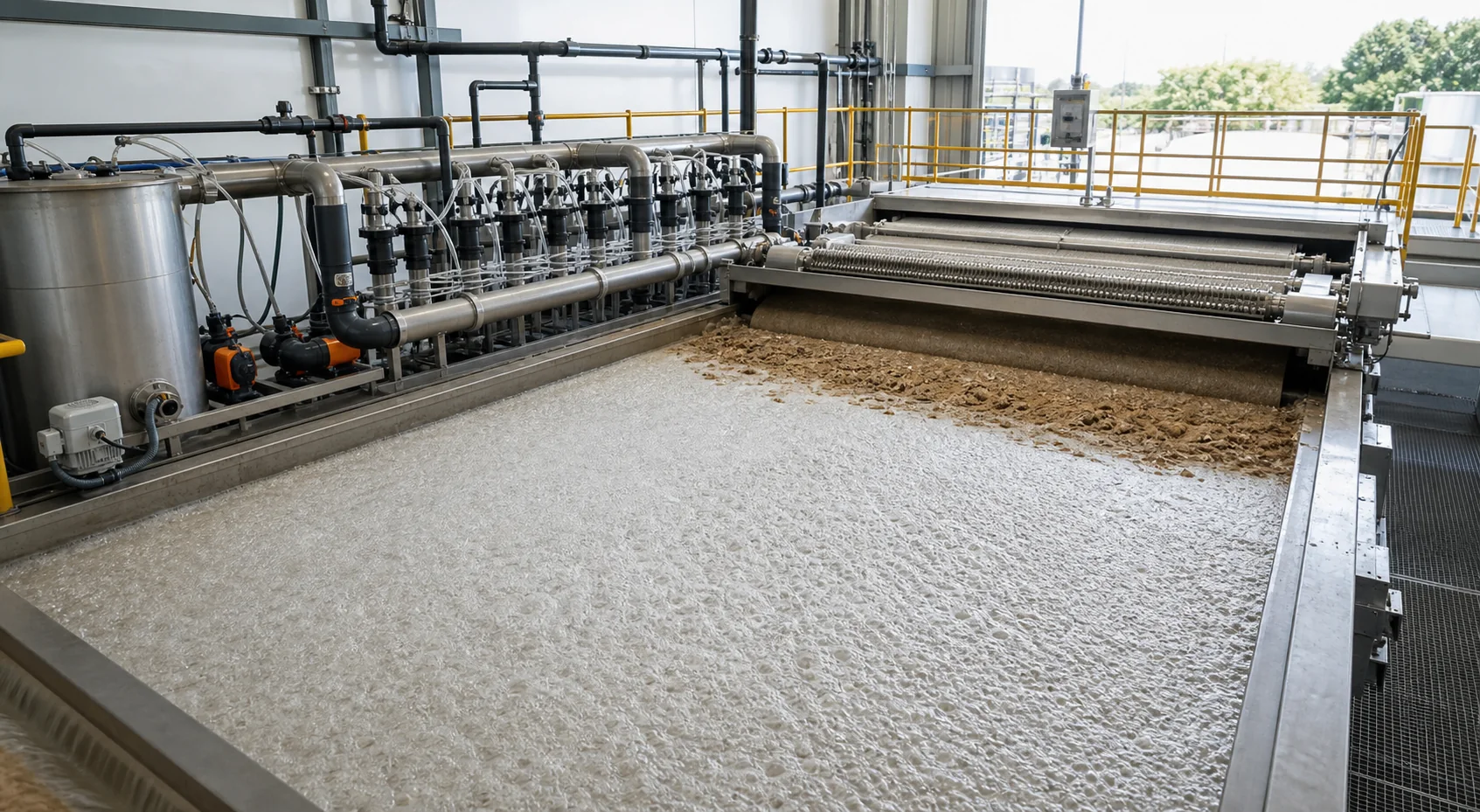
Describe the conditioned float
Record the production and cleaning contribution, upstream coagulant and polymer, float withdrawal, storage age and dry solids. Note changes in fats, temperature and any blending before dewatering.
Sample at the downstream polymer contact point. Fresh skimmed float can behave differently from stored or mixed sludge, so the supplier needs the material that the separator actually receives.
Keep the existing DAF program visible
Document upstream chemical codes and dose ranges. Residual conditioning and changes in coagulation can affect the second polymer screen, even if the dewatering machine has not changed.
Do not alter both DAF chemistry and downstream conditioning during the first comparison unless the trial is explicitly designed for that combined change. Otherwise the source of any improvement remains unclear.
Use a machine-specific endpoint
For a belt or screw press, record drainage, filtrate solids, cake discharge and throughput. For a centrifuge, pair centrate quality and cake solids under stable approved settings.
Prepare each candidate correctly and compare a dose band with the incumbent. A good-looking drainage sample or large floc is insufficient if capture, media release or cake handling fails the agreed limit.
Include storage and transfer effects
Observe how the sludge changes across its actual storage interval and transfer path. Check feed homogenization, delivery calibration and solution age before blaming the replacement product.
The CPAM preparation record helps separate uncertain stock from a changed float feed. Repeat difficult but representative conditions rather than extending one fresh-sample result to every operating shift.
Buy the second duty explicitly
Specify the downstream application, qualified code, preparation, feed envelope and acceptable return-liquor and cake conditions. Keep its chemical consumption separate from the DAF program when comparing cost.
Use the dairy float-dewatering enquiry with the complete treatment-train record. Ask whether the proposed supply changes only the second polymer or also depends on upstream chemistry, equipment or storage changes that require separate approval.
A two-duty purchasing record
Keep one line for the DAF conditioning program and another for downstream dewatering: code, commercial consumption, injection point and accepted endpoint. Record the age and blend of float when it reaches the second separator. A change in upstream polymer or coagulant should be traceable even if the second chemical stays unchanged.
During a comparison, note whether the observed gain belongs to float formation, storage behavior, dewatering or several controlled changes. Quote chemical cost for each duty separately before calculating a combined program cost. That makes a second-stage CPAM order answerable and avoids attributing all improvement to the final injection while its feed chemistry was also altered.