
Separate continuity from optimization
State whether the goal is backup supply, price, delivery flexibility or improved performance. An equivalent backup can be valuable without an invented dose-saving claim.
Keep the incumbent code, documents, preparation procedure and accepted plant record. Preserve enough approved material for a comparison and safe rollback rather than testing only after regular stock is exhausted.
Align the technical offer
Request proposed code, TDS, SDS, COA format, active definition and relevant test methods. Resolve charge and molecular terminology before matching numerical descriptions.
If the replacement changes form or activation, treat equipment and operating scope as part of the proposal. An emulsion and a powder cannot be exchanged by equal pump speed or commercial mass alone.
Compare representative feed in parallel
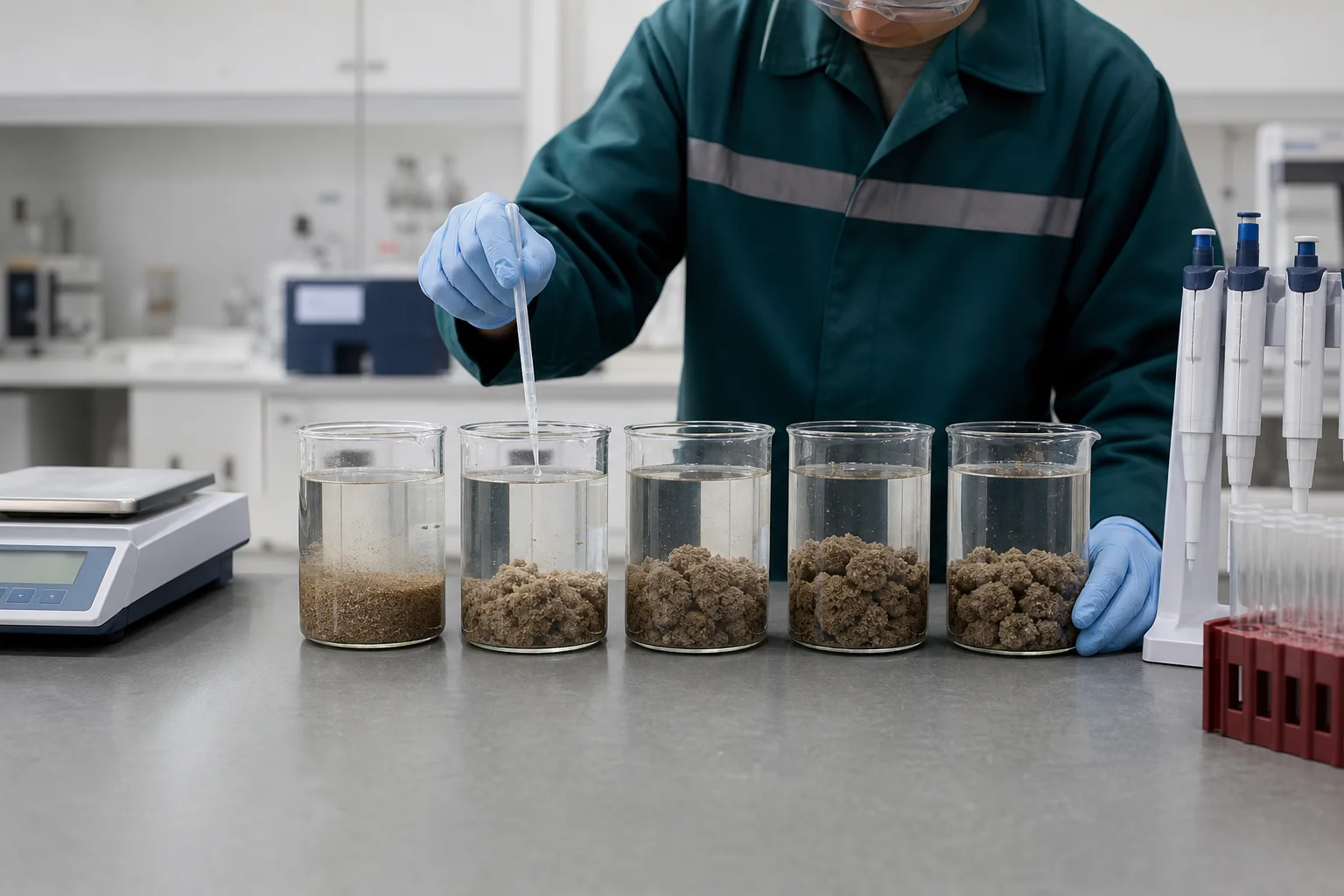
Use properly split current feed and appropriate preparation for each candidate. Include the incumbent throughout and compare dose bands, not only one arbitrary setting.
Repeat important difficult blends. Keep solution age and commercial versus active basis explicit. The charge-profile framework explains candidate differences but does not replace the installed machine's approval.
Manage the production switch
Calibrate delivery and hold feed and equipment as stable as practical. Allow residence before sampling and record every upstream or mechanical change that affects interpretation.
Measure capture, cake, throughput, handling and preparation burden. A lower chemical consumption is not a complete equivalence result if return-liquor solids or operator work increase beyond the accepted condition.
Record substitution permission precisely
Name both qualified supplier codes and their preparation standards, useful dose bands and feed limits. State whether changeover can be routine or requires a planned operating review.
Use the second-source CPAM enquiry with the benchmark and trial scope. Keep supply and delivery claims subject to verified proposals; do not infer factory stock, capacity or guaranteed lead time from a successful laboratory comparison.
A supplier-equivalence permission record
Name incumbent and candidate codes, document methods, commercial form, preparation procedure and qualified feed range separately. Enter accepted dose bands and equipment endpoints for each rather than forcing the replacement to inherit the incumbent's pump setting.
Specify what purchasing is allowed to substitute after approval and what still needs an operating review. A second source can be accepted for continuity without proving identical chemistry or universal interchangeability. Keep the retained control and comparison data available for the first delivery so an unexpected result can be investigated before another unapproved product or mixed stock obscures its cause.