
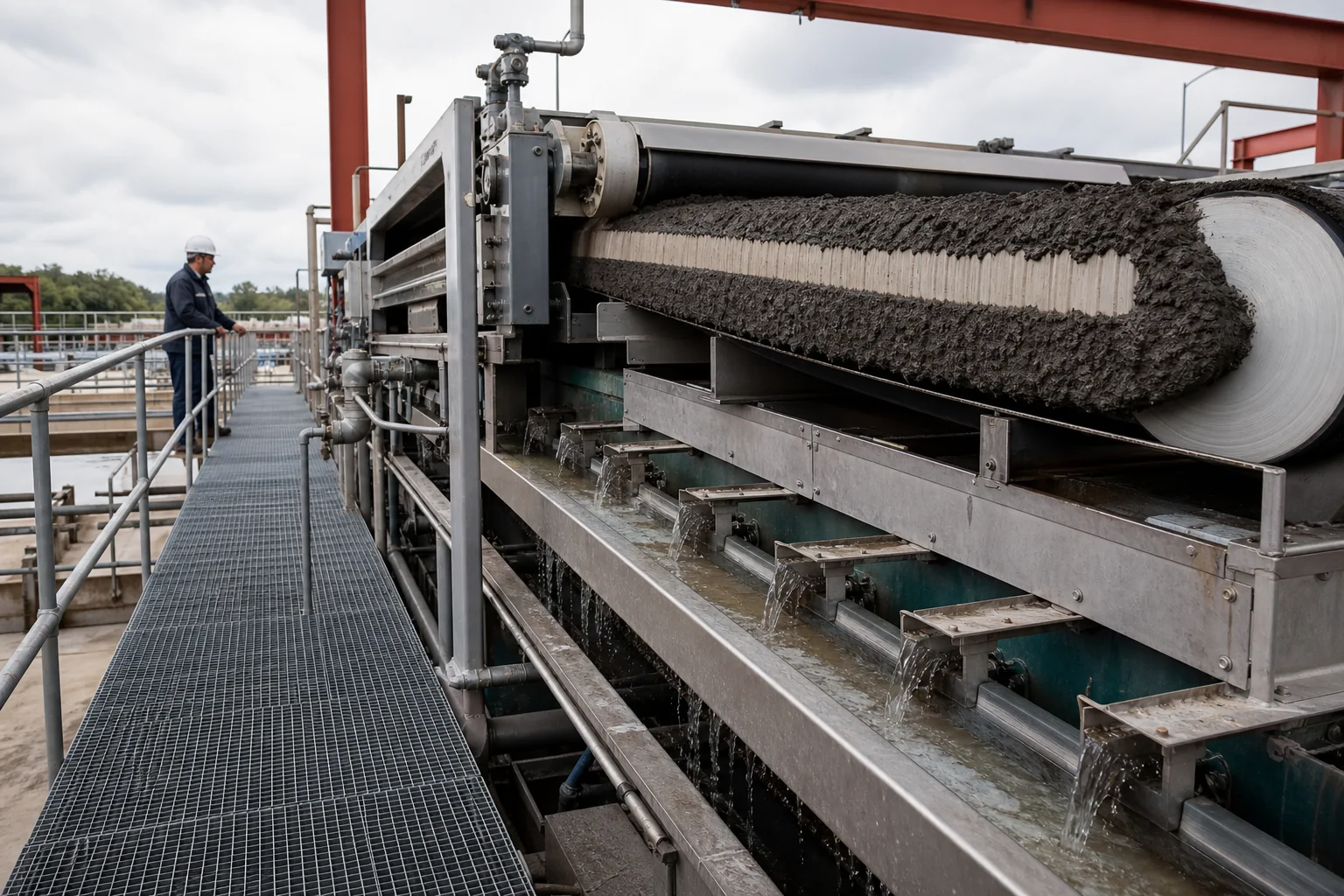
Separate biological and chemical solids
Describe sludge sources, biological treatment, precipitation, blend and age. Provide dry solids, pH and relevant process additives or metals where they affect the duty.
Do not assign cationic polymer solely from the factory's industry. A changing inorganic fraction may justify a broader charge-family screen. Representative testing should decide the candidates.
Use the actual filter constraints
Provide media, feed arrangement, normal operating sequence and approved pressure or squeeze conditions. State the target that constrains the plant: capture, cake solids, throughput, handling or disposal.
Use a test method linked to those conditions. A jar can show conditioning response but does not reproduce pressure, cake compression or the complete filtration path.
Measure the whole cycle
Follow filtrate quality and volume development, filling, pressing or squeezing where applicable, opening, discharge and cleaning. Record cake dry solids using a consistent sampling method.
Faster initial drainage does not necessarily shorten total cycle time. A sticky cake or blinded cloth can erase the apparent gain, so retain operator observations and maintenance effects in the comparison.
Normalize consumption at accepted quality
Calibrate product and solution flows and keep the mass basis explicit. Compare as-supplied consumption per dry-solids tonne while holding capture and acceptable cake handling constant.
If plant behavior differs from bench work, use the conditioning investigation to check stock preparation, transfer shear and feed change before escalating molecular weight or charge.
Release the right application
Request an interpretable sample set, a practical trial quantity and the supporting documents. Preserve benchmark material and define who can approve or stop the plant comparison.
Use the filter-press CPAM RFQ with the equipment sheet and measured targets. Keep the approved code tied to that feed and media; neither a generic dewatering description nor success on another separator proves press-specific performance.
A complete-cycle comparison record
Separate filling, pressure or squeeze stages where applicable, opening, discharge and cleaning in the trial timing sheet. Record representative filtrate and cake samples alongside total accepted dry-solids throughput. Keep the media identity and its starting condition explicit so a cleaned cloth is not unknowingly compared with a fouled benchmark.
List interventions such as manual scraping or extra washing even when the clocked filtration stage became shorter. If cake sampling varies across the plate pack, agree a representative compositing method with the plant team. These controls make a supplier comparison more useful than reporting one drainage volume or a single unusually dry piece of cake.