
Describe the blend and variation
Record each sludge source, typical and difficult blend, storage age, dry solids, pH and upstream chemistry. Identify whether blend changes are gradual or abrupt.
Take representative samples at polymer contact and preserve fines. Keep sampling and mixing consistent so variation in the laboratory split is not mistaken for anionic or cationic product preference.
Define the installed duty
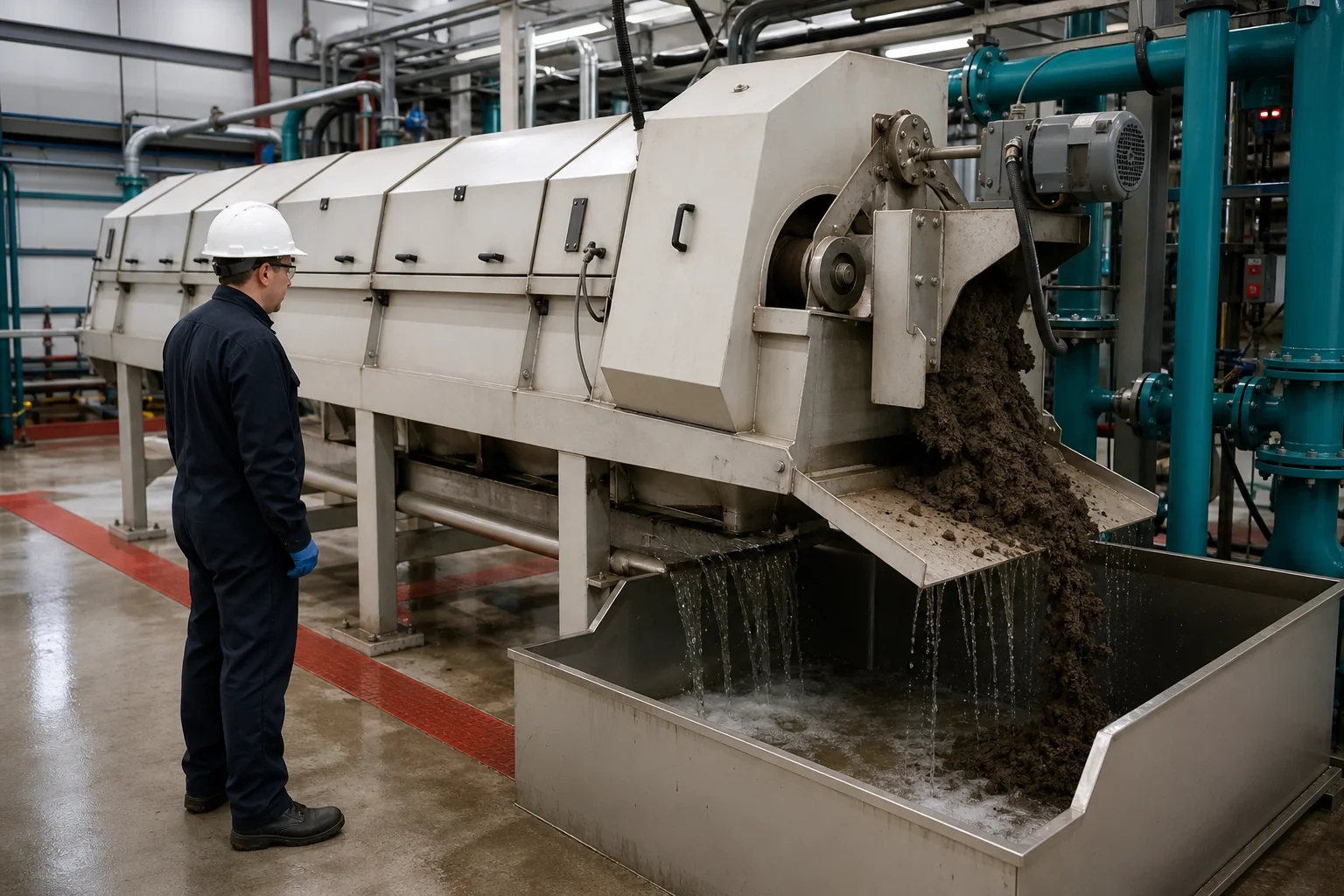
Provide screw-press model, feed rate, conditioning arrangement and approved operating settings. Identify the equipment limitations that must remain unchanged during the comparison.
Keep machine adjustments under the responsible operator's control. A supplier's polymer recommendation is not authorization to change pressure, speed or other settings outside manufacturer guidance.
Compare the useful operating band
Prepare the incumbent and proposed grades appropriately, documenting code, active or commercial basis, concentration and age. Screen multiple doses and repeat promising conditions.
Record filtrate solids or the required water measure, cake dry solids, discharge behavior and throughput. Floc appearance can help diagnose response but cannot replace those paired endpoints.
Check continuity over a production period
Observe preparation turnover and calibrated solution delivery as the sludge blend changes. A stable metering setting does not maintain a constant dose per dry tonne when solids loading moves.
The dry-solids dose record exposes that change. If response deteriorates, compare feed, preparation and delivery against the accepted record before assuming a different shipment is necessary.
Write a bounded repeat-supply approval
Agree accepted blends, preparation conditions, dose range and equipment limits. State how a new industrial contribution or upstream coagulant change triggers review.
Send these conditions with the screw-press CPAM quotation request. Keep a benchmark and rollback plan during a supplier switch, and do not extend the approval automatically to another screw press with different feed or conditioning residence.
A blend-to-approval matrix
List the sludge blends production must handle, with measured dry solids, storage age and the known upstream chemical state for each. Beside each tested condition, enter the qualified code, preparation, commercial dose band, filtrate result and discharge observation. Do not populate an untested blend with a result inferred from a neighboring row.
Identify the operator action when the feed moves beyond that matrix: verify loading and stock first, then repeat a bounded screen if the chemistry truly changed. Keep that response instruction with purchasing. It protects a repeat supply decision without falsely declaring one product universally suitable for every biological and chemically precipitated sludge mixture.