
Build a sludge identity record
Identify primary, waste-activated, digested, mixed or industrial sludge. Include blend ratio, storage time, feed dry solids and any upstream chemical change. Preserve the sample’s fine fraction and avoid comparing material collected from different feed conditions.
Treat a change in digestion or industrial contribution as a reason to recheck the operating range. Increasing product dose without identifying a solids-loading change can hide the real cause of poor capture.
Match the test to the machine
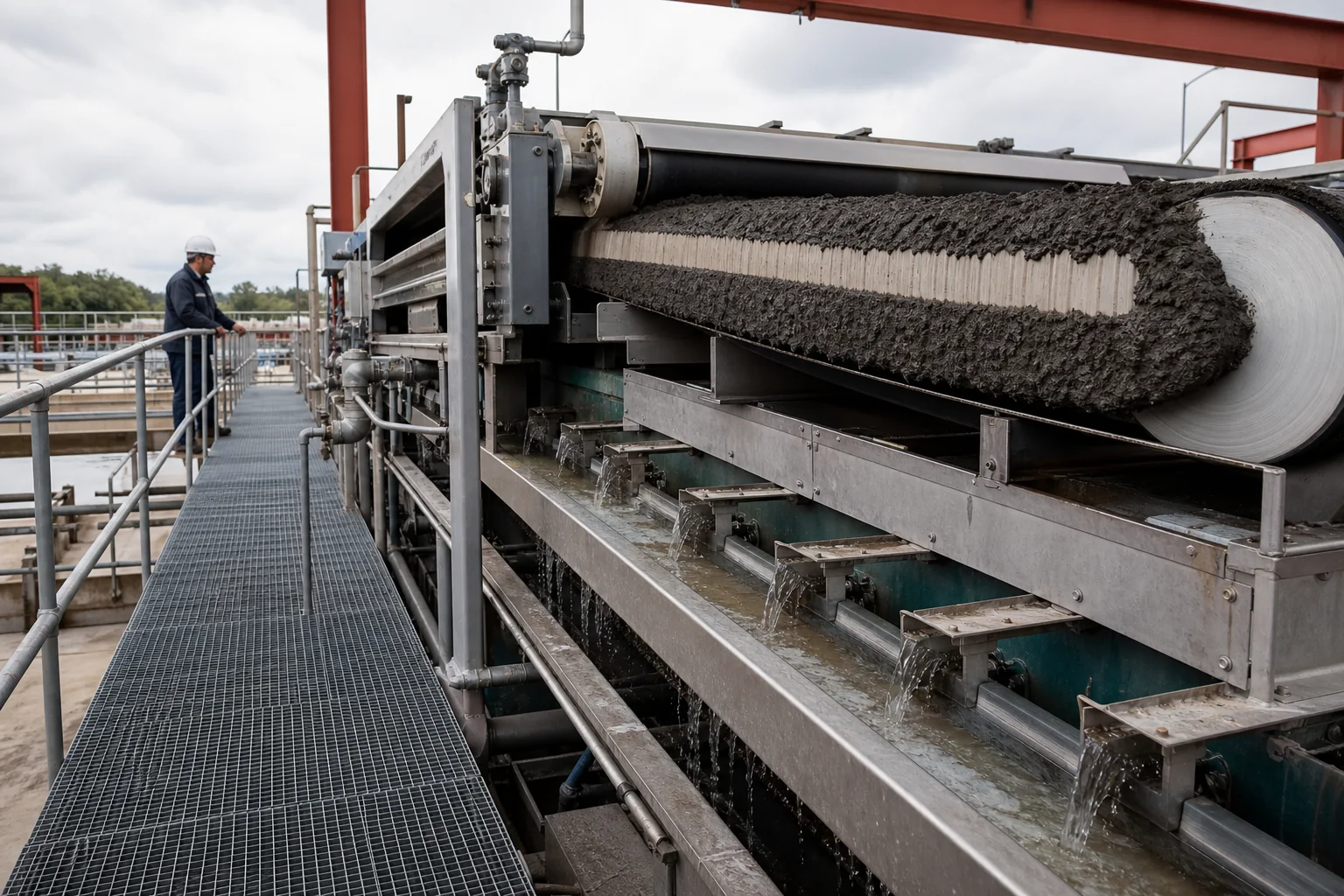
For a belt press, observe free drainage, distribution, side losses and cake release. For a screw press, include filtrate quality, loading and discharge behavior. For a centrifuge, compare centrate, cake and throughput while recording relevant machine settings.
A jar or drainage test narrows the sample set; it does not reproduce every mechanical stress in a full-scale separator. Confirm the finalist during a controlled plant run, allowing sufficient process residence before collecting results.
Report both streams and the dose basis
Record cake solids and return-liquor suspended solids together. A drier cake is not an improvement if solids losses increase beyond the plant’s acceptance condition. Compare commercial consumption per dry tonne, not only solution pump speed.
Use the dry-solids dose calculation and wet-cake troubleshooting sequence when bench performance and production disagree.
Purchasing records for this duty
- CPAM for Digested-Sludge Centrifuges: Prepare a Trial RFQ — Request centrifuge polymer trials with digested-sludge identity, dry-solids load, centrate, cake, preparation and stable machine settings.
- CPAM for Belt Presses: Buy Against Drainage, Capture and Release — Qualify cationic polymer for activated-sludge belt pressing with free drainage, side losses, filtrate, cake release and repeatable plant consumption.
- CPAM for Screw Presses: Qualify Mixed-Sludge Supply — Specify screw-press polymer trials using sludge blend changes, loading, filtrate solids, cake handling and prepared-solution continuity.
- CPAM for Industrial Sludge Filter Presses: Buying Checklist — Compare cationic polymer offers for industrial biological sludge filtration against filtrate, cake, cycle time and media handling.
- CPAM for Dairy DAF Float: Buy for the Second Dewatering Duty — Qualify cationic polymer for dairy flotation sludge separately from the DAF program using actual float age, composition, filtrate and cake handling.
- CPAM for Slaughterhouse Sludge: Build a Representative RFQ — Request cationic polymer trials with slaughterhouse sludge sources, flotation and biological blends, storage, capture and disposal acceptance.
- CPAM for Paper-Mill Biological Sludge: Define Repeat-Supply Limits — Qualify cationic polymer for paper-mill sludge with biological and fiber blends, filler changes, preparation, dewatering and documented grade control.